Port of Olympia Blog
The Port of Olympia began testing for historic contamination in Budd Inlet in 2024 under an Agreed Order with the Department of Ecology. Although the Port is leading the investigation of Budd Inlet sediment contamination, it is expected that other liable parties will be identified as we continue the investigation.
Over the past two years, Port scientists and research crews have worked diligently to conduct a thorough investigation, collecting thousands of sediment samples in East and West Bays. We recently shared results from our first round of testing in East Bay and are now ready to share the results from our second round of testing in West Bay.
West Bay Sediment Testing
In January 2025, our research team conducted two months of sediment sampling in the West Bay of Budd Inlet. This included the area from the 5th Avenue Bridge up to West Bay Marina and east to the peninsula.
Like previous sediment testing in East Bay, sediment samples were collected from different locations and depths to get a clear picture of sediment conditions:
- Surface samples – from the top layer of mud and debris.
- Intertidal samples – from areas exposed at low tide.
- Subsurface samples – from deeper layers below the surface.
Encouraging Results
Sediment samples were sent to labs in Washington and California where they were analyzed by a highly specialized team of marine experts, project consultants and scientists. The results, while not final, have been reviewed and we are encouraged by the results.
We found surface dioxin and furans above screening levels in two areas: in scattered locations at the north end of the testing site and under the marinas to the south. Most of the samples came back at less than twice the screening level.
This is good news. In many cleanup projects, levels can be 10, 100, or even 1,000 times higher than the screening level. What this means is that the low levels detected in West Bay do not pose a major threat to marine life or human health. It also potentially means less dredging will be necessary and we can allow Mother Nature to do much of the work through natural recovery.
As with the dioxin and furans, we also found relatively low levels of polycyclic aromatic hydrocarbons (gas and diesel) in the following four areas. Once again, we are hopeful that lower levels could mean reduced dredging and cleanup costs in the future.
- Under West Bay Marina
- Along the western shoreline consistent with outfalls
- Under the Marine Terminal berth
- Under the private marinas along Percival Landing.
Screening Levels Explained
- The “screening level” is the level of contamination at which action may need to be taken.
- For dioxin/furans, that level is 19 ng/kg—the equivalent of one drop of water in 20 Olympic-sized pools.
- In many cleanup projects, levels can be 10, 100 or even 1,000 times higher than the screening level.
Third Round of Testing: Northern Budd Inlet
With testing completed in both East and West Bays, the Port is now ready to sample the northern section of Budd Inlet. Although we may perform additional spot
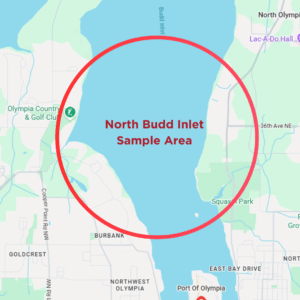
sampling as necessary, this will be the final round of sediment testing.
The sample area extends from West Bay Marina north to about the midway point of Budd Inlet. While we will take fewer samples from this area, like last time, we will collect samples from different locations and depths to get a more complete picture of the sediment conditions.
Research scientists will begin testing in March, and finish by mid-April. They will be based in a trailer inside the Marine Terminal fence for the duration of the sampling. We expect to start receiving the testing results by the end of the year and be able to share our findings by early 2027.
What’s Next?
Once the sediment testing is complete in the third and final sample area, our project team will work with the Department of Ecology to develop a cleanup plan.
Based on what we know at this time, the likely cleanup actions will include:
- Dredging (removing contaminated sediment) in areas like Moxlie Creek, the navigation channel and the Marina & Boatworks area.
- Capping (placing clean material over contaminated sediment) natural recovery in areas where dredging isn’t needed.
- Exploring habitat restoration opportunities, such as at West Bay Park Lagoon.
As always, we will continue to share updates with the community on our website and blog. Be sure to sign up for Budd Inlet Updates below!